
Power outages can instantly shut down servers, network hardware and medical equipment. A reliable UPS bridges the gap between mains failure and generator startup, but the whole system lives or dies by its battery. Many buyers mistakenly fit standard stationary batteries into UPS units, only to face voltage drop and unexpected shutdowns under sudden heavy loads.
Standard batteries are built for slow, long-duration discharge. UPS systems, however, demand immediate burst power the moment grid power fails. High rate current battery is specially engineered for this short, powerful discharge, featuring low internal resistance to maintain stable voltage when the UPS switches to battery mode. This is the core difference separating high-rate standby batteries from regular deep cycle batteries.
For most rack and tower UPS used in offices, server rooms and security systems, 12V high rate batteries remain the most widely adopted solution. Their compact size, sealed maintenance-free design and fast response make them easy to install and replace in standard UPS battery compartments. Instead of delivering power over hours, they focus on supplying peak power for 5–15 minutes, long enough to safely shut down devices or wait for backup generators.
For larger industrial UPS deployments, High Rate Battery pack is assembled by connecting multiple high-rate cells together. These custom packs are built to handle bigger total loads for data centers, factory control panels and hospital power backup. Proper matching of cell specifications, wiring and thermal management is critical to avoid uneven discharge and extend overall service life.
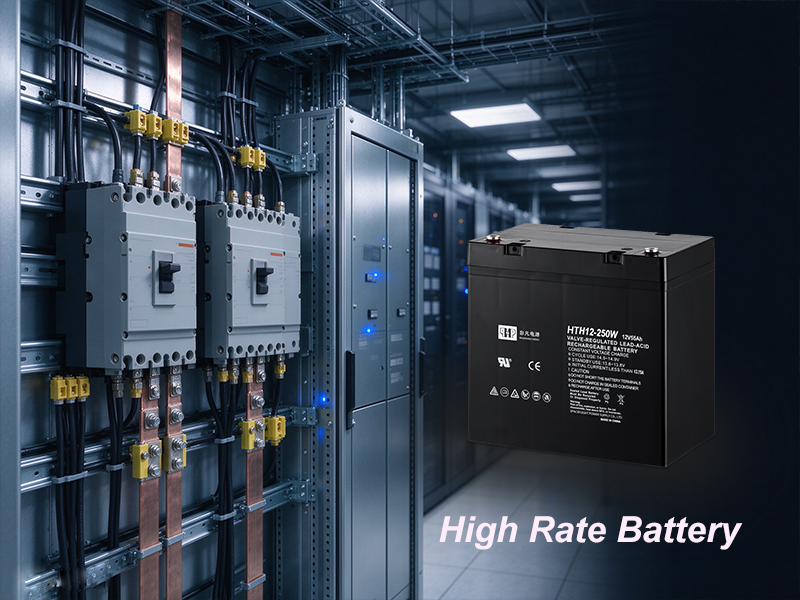
What key points should you check when selecting UPS high-rate batteries?
First, confirm watt rating instead of only looking at Ah capacity. High-rate batteries are rated by power output for a fixed discharge time, which matches UPS load requirements better than ampere-hour ratings.
Second, verify operating temperature range. High-rate performance drops sharply in extreme heat or cold. Server rooms usually have controlled temperatures, but outdoor or unconditioned cabinet installations need extra thermal protection.
Third, follow float charging recommendations. High-rate VRLA batteries require precise charging voltage. Overcharging causes premature aging, while undercharging reduces discharge capability during blackouts.
Fourth, plan regular maintenance and replacement cycles. Even well-built high-rate standby batteries degrade gradually over years. Schedule periodic load testing to ensure they can still deliver the required burst current in a real power failure.
If your UPS protects mission-critical equipment, never substitute ordinary batteries for high-rate models. With the correct battery choice, your UPS will reliably deliver instant backup power whenever the main power supply cuts out.