
RV travel lets you explore off-grid destinations freely, and reliable power is the backbone of every comfortable road trip. Picking the wrong battery can leave you without lights, refrigeration or essential electronics in remote locations. Many RV owners turn to sealed deep cycle options, and 12V Marine/RV deep cycle batteries remain one of the most trusted choices for mobile living.
When shopping for RV power storage, it is critical to understand the difference between starter batteries and deep cycle batteries. Starter batteries deliver short bursts of high current only to fire up engines. Deep cycle batteries are engineered to repeatedly discharge most of their stored energy and recharge, which matches the daily power consumption pattern of RV appliances. Among these options, the agm deep cycle marine battery is widely preferred by RVers and boaters alike. Its absorbed glass mat construction holds electrolyte inside fiberglass separators, creating a spill-proof, maintenance-free sealed unit. No need to add water regularly, which is perfect for bumpy RV journeys and unstable marine environments.
What makes an agm marine battery stand out for RV use? Strong vibration resistance is a major advantage. As your RV travels over rough roads, constant shaking can damage ordinary flooded batteries. AGM internal structure protects the plates from vibration damage, extending service life. It also handles partial state of charge cycles better than traditional flooded batteries, which is common for RV systems powered by solar panels or alternator charging.
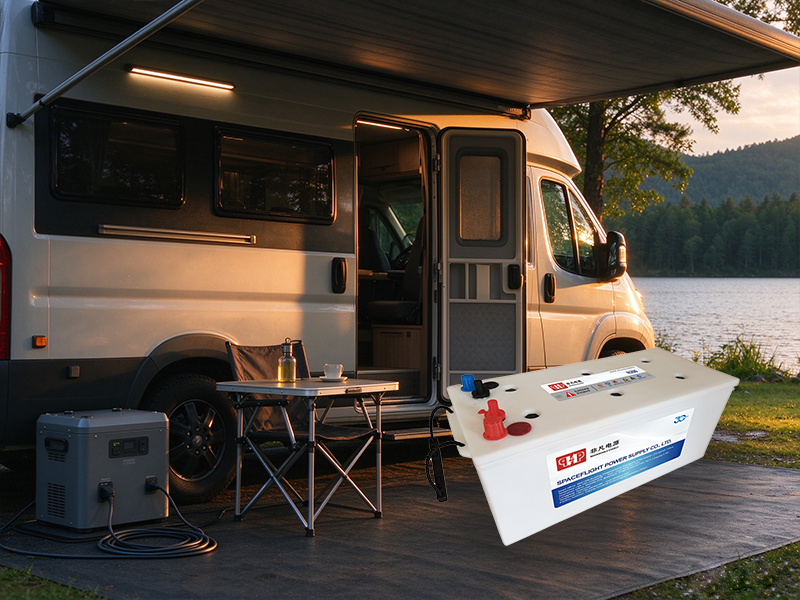
If you want a battery built to serve both marine vessels and recreational vehicles, an AGM Marine/RV Battery is designed for dual-scenario heavy-duty use. It balances deep cycling performance and stable voltage output, whether you power RV kitchen equipment, cabin lighting, water pumps or marine accessories.
Now let’s walk through the key factors when selecting your RV battery. First, calculate your daily power consumption. List all electric devices you will run off-grid, then select the proper Ah capacity. Weekend campers may choose smaller capacity batteries, while full-time RV dwellers need higher Ah ratings or battery banks to support long off-grid stays.
Second, check installation space and weight. AGM batteries are heavier than lithium alternatives, so confirm your RV battery compartment dimensions and load limits before purchase.
Third, verify charging compatibility. AGM batteries require a specific charging voltage profile. Your solar charge controller, inverter or alternator charger must support AGM charging settings to avoid undercharging or overcharging, both of which shorten battery life.
Fourth, evaluate cycle life and operating temperature range. AGM batteries perform reliably in moderate temperature changes. If you often camp in extreme cold or hot climates, you need to take temperature impacts on battery capacity into consideration.
Finally, always prioritize genuine deep cycle models instead of dual-purpose starter batteries for your RV house bank. Starter batteries cannot sustain repeated deep discharge and will fail quickly when used for daily living loads.
For most RV enthusiasts looking for low-maintenance, rugged and affordable off-grid power, AGM deep cycle options are a solid investment. Whether you are planning weekend camping trips or long cross-country journeys, well-selected 12V Marine/RV deep cycle batteries will keep your RV power system steady, so you can enjoy every adventure without worrying about unexpected power outages.