
Have you ever been in such an awkward situation: the important document you’re rushing to finish hasn’t been saved yet, and a sudden power outage makes all your efforts in vain; the company server suddenly shuts down due to unstable voltage, causing the order inquiry system to crash; the precision instruments in the laboratory lose all the hard-collected data due to an instantaneous power failure… All these frustrating scenarios can actually be avoided by a “small device” – it is UPS (Uninterruptible Power Supply). And the core that supports this “power security guardian” to operate is precisely those batteries that silently store energy, such as Sealed Lead Acid Batteries (commonly known as SLA Battery).
First, let’s clarify a basic question: What exactly is UPS? Simply put, a UPS is a device that connects the host to a Storage battery and converts direct current (DC) into mains alternating current (AC) through circuits such as the host’s inverter. It is like a “buffer zone” between the equipment and the power grid. When the mains power is normal, it not only supplies stable power to the connected equipment but also charges the internal storage battery; once the mains power is cut off, unstable or fluctuates sharply, it can immediately switch to the battery power supply mode, ensuring that the equipment can continue to operate for a period of time, buying precious time for data saving and equipment shutdown.
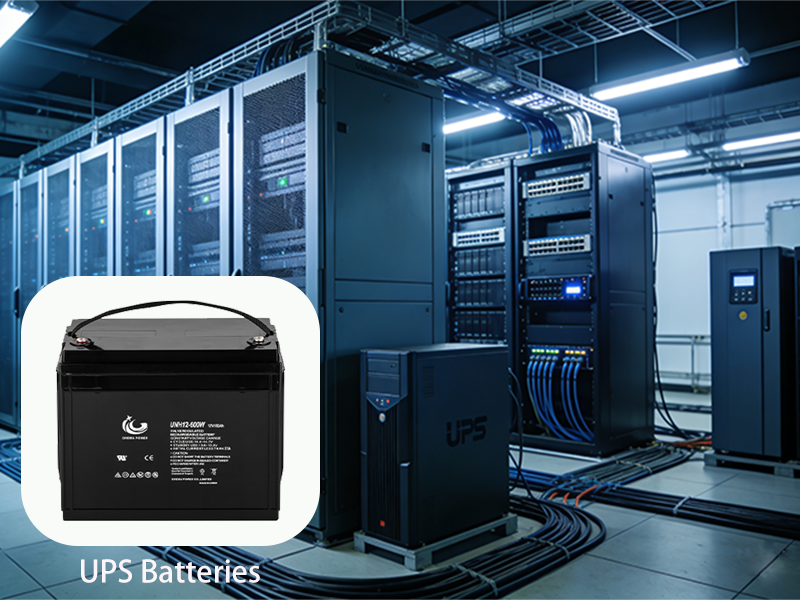
Why is UPS so indispensable in modern life and work? The answer lies in its three core functions: voltage stabilization, power noise filtering, and uninterruptible power supply. For sensitive electronic equipment such as computers, servers, and precision sensors, even a slight voltage fluctuation may cause component damage or data errors. The UPS can effectively suppress power grid interference and provide a “clean” power environment for the equipment. Especially in industries such as finance, medical care, and data centers, the interruption of power supply for even one second may lead to immeasurable losses, so UPS has become a necessary supporting equipment.
As the “energy heart” of UPS, the performance of UPS Batteries directly determines the reliability of the entire UPS system. Among the many battery types used in UPS, Sealed lead acid batteries (SLA Battery) are widely favored due to their stable performance, low maintenance cost, and good safety. Unlike traditional open lead-acid batteries, SLA Battery has a sealed structure, which avoids electrolyte leakage and is more suitable for indoor use in offices and data rooms.
For some UPS systems that need to provide high-power output in a short time (such as supporting server clusters or large-scale communication equipment), High Rate Battery has become a better choice. This type of battery can release a large amount of current in a short time, ensuring that the UPS can quickly respond to power failures and drive high-power equipment to operate normally. Among them, 12V high rate batteries are the most commonly used specifications in medium and large UPS systems. Their standardized voltage and excellent high-rate discharge performance make them easy to combine in series and parallel to meet different power and capacity requirements.
To sum up, UPS is not just a simple “power backup device”, but a “power security barrier” for electronic equipment. And behind this barrier, Sealed lead acid batteries, High Rate Battery and other UPS Batteries are the silent contributors. Whether it is a home office, a corporate data center, or a key industrial site, choosing a UPS system equipped with high-quality batteries is equivalent to giving a “safety guarantee” to the normal operation of the equipment.